
May I wish you a peaceful Christmas and all my thanks for your support for British Sea buckthorn over 2022. Let us all look forward to making next year a memorable one that sees a brighter future for humanity and our planet.
Happy Christmas.
May I wish you a peaceful Christmas and all my thanks for your support for British Sea buckthorn over 2022. Let us all look forward to making next year a memorable one that sees a brighter future for humanity and our planet.
Happy Christmas.
Goodbye 2022 – Christmas is approaching and it is a time for reflection and promise of better things to come.
This year we saw temperatures in the UK soar to 40 deg. C. It came within a long summer drought. There have been droughts before, but the high temperature signposted a climate change issue for the future.
On the land, drought impacts deep into the soil. Soil is the heart of the countryside. Above ground we focus on plants and trees, but below ground we have little knowledge of a complex world from which our crops – and our food, comes from. It is silent and unseen, but it is vibrant; active and diverse. It provides the nutrients for our plants. It can be used as an asset to improve the quality of our food; store and control the water from rainfall; be the backbone that delivers the health of all things in the countryside.
Within the complex world that we live, we choose how to manage our lives. As farmers, science has directed us to use chemicals to control pests and increase crop yields that can be delivered at lower cost. 40 deg C this summer was a signpost of climate change. It can be logged as a statistic, or reflected on as to its meaning.
Decisions one takes on a personal basis. For me, as a farmer – and grower of sea buckthorn, the 40 deg statistic I see as a threat that will dry up my soils, crops, grass for livestock, habitat for wildlife. I see it as a challenge and an opportunity for change.
My son, Ben, suggested I should go to an agricultural event this summer called Groundswell. I had not been before and was not prepared for the outcome.
It was a dynamic show, full of enthusiastic people with innovation at the front of their thinking. Agriculture is often portrayed as full of aging farmers with few people joining the industry. Here at Groundswell was inspiration. Inspiration that was real, creative and active. A signpost for me that taking up the opportunity for change is worthwhile.
So what was the outcome?
Back in the summer, the drought had had a profound impact on the sea buckthorn. This year our Siberian plants produced berries – but long before they were ripe, thirsty wildlife striped the plants of the crop. Our Latvian plants, which have been reliable were stressed by lack of water. Their crop was small and later ripening varieties had almost no crop. Our german varieties ripened earlier than usual, but the berries were small.
I have not installed irrigation as up until now the plants have not needed it, and water is a precious resource that if overused can fill fruit with water and dilute nutritional quality. This season’s drought and high temperature indicates that if high temperatures are coming with climate change, then we have to change the ways we farm.
So as 2022 comes to an end, with the war in Ukraine still waging. With high energy and inflation impacting into everything we do – 2022 has to be the year to trigger change.
The decision therefore has been to change the way we farm. We are going organic. I do not say this lightly. It means a huge change needing new skills, new machinery, new buildings, new crops, new ways of manging our precious soil. It is daunting to be doing this at a time of economic instability, but that will ease. But I do not believe climate change will ease. Going organic is a long term project – 10, possibly 12 years to regaining the vibrancy of our soils. A long time, but it is no longer than it has taken to understand how to grow sea buckthorn.
And the sea buckthorn – what of it? What to do? We are lucky that the European sea buckthorn growers are, like those at groundswell, a dynamic group. There have been three on-line conferences providing the opportunity to share knowledge.
So like the farm – for sea buckthorn at Devereux farm – 2022 is a time for change. Time to decide which varieties have been successful and which not. Time to decide on how to lay out orchards that provide for a crop that can thrive in an extreme, changing climate.
So many old plants are going to be pulled up and replanted with new. With varieties that produce the fruit that we believe our customers like best.
Without customers we would not have a purpose. I find that our customers – like those attending groundswell, they know what they want. Many have a desire for the sea buckthorn they ate in other countries. Many understand this special fruit for its taste; its nutritional quality; its potential to inspire new culinary innovation.
So as 2022 comes to an end, I look forward to 2023 with a passion for change. Change that I hope will provide a future for our soil; our countryside; our crops and providing something special for our customers.
As you have now read this, the chances are you are one of our customers, if not you will have an interest in sea buckthorn. For both reasons may I thank you and wish you too, a happy Christmas and let us hope that 2023 brings stability and peace to a world that has many issues to solve.
Happy Christmas
One last thing – I am afraid that last orders for sea buckthorn berries has to be drawn to a close for 2022.
LAST ORDERS WILL BE ON DECEMBER 19th for delivery on DECEMBER 20th.
2023 I will be writing a short blog each week as our new farm emerges – new orders for sea buckthorn berries will start in January.
THANK YOU FOR ALL YOUR SUPPORT IN 2022.
On Monday 8th March at 7.30-8.30pm we will be holding a free webinar all about introducing you to gut health. What is it and why should we be thinking about it? How does it relate to sea buckthorn and how can you impact your own gut health? Join BSC Director Matt Swain and Dr Lucy Williamson for a full discussion about it.
Dr Lucy Williamson is a freelance nutritionist and former vet from Hertfordshire. She works with British farmers and food producers through her Food LINKS initiative, advising them and helping with product development and marketing using evidence based nutritional science. In addition, she is a Visiting Lecturer in Nutrition and Dietetics at the University of Hertfordshire, nutritionist for Love British Food and runs her own Nutrition Consultancy. She has been working with the British Sea Buckthorn Company for a couple of years.
HOW DO I REGISTER FOR THE WEBINAR?
Simply click this link and register with your details. You will then receive an email with the link for the webinar and registration details for the event.
WHEN IS THE WEBINAR?
Monday 8th March at 7.30pm via zoom.
WILL THE WEBINAR BE RECORDED?
Yes, the webinar will be recorded. You will have the option of switching off your video during the recording. It will be available on YouTube following the event.
WILL I BE ABLE TO ASK QUESTIONS?
Yes, there will be 20 minutes available when you will have the opportunity to ask Lucy questions.
HOW DO I FIND OUT MORE?
Email us at info@britishseabuckthorn.com if you have any questions.
As a Registered Nutritionist passionate about natural, nutrient-packed foods for our best health, I’m privileged to be working with the team at The British Seabuckthorn Company.
My previous career as a Vet, began to teach me the power of nutrition for best health; my interest in small animal practice was always Dermatology – the treatment of skin disease. So, the Canine Shine project, just pure, natural seabuckthorn berries, a power-pack of nutrients for skin health, is an exciting journey!
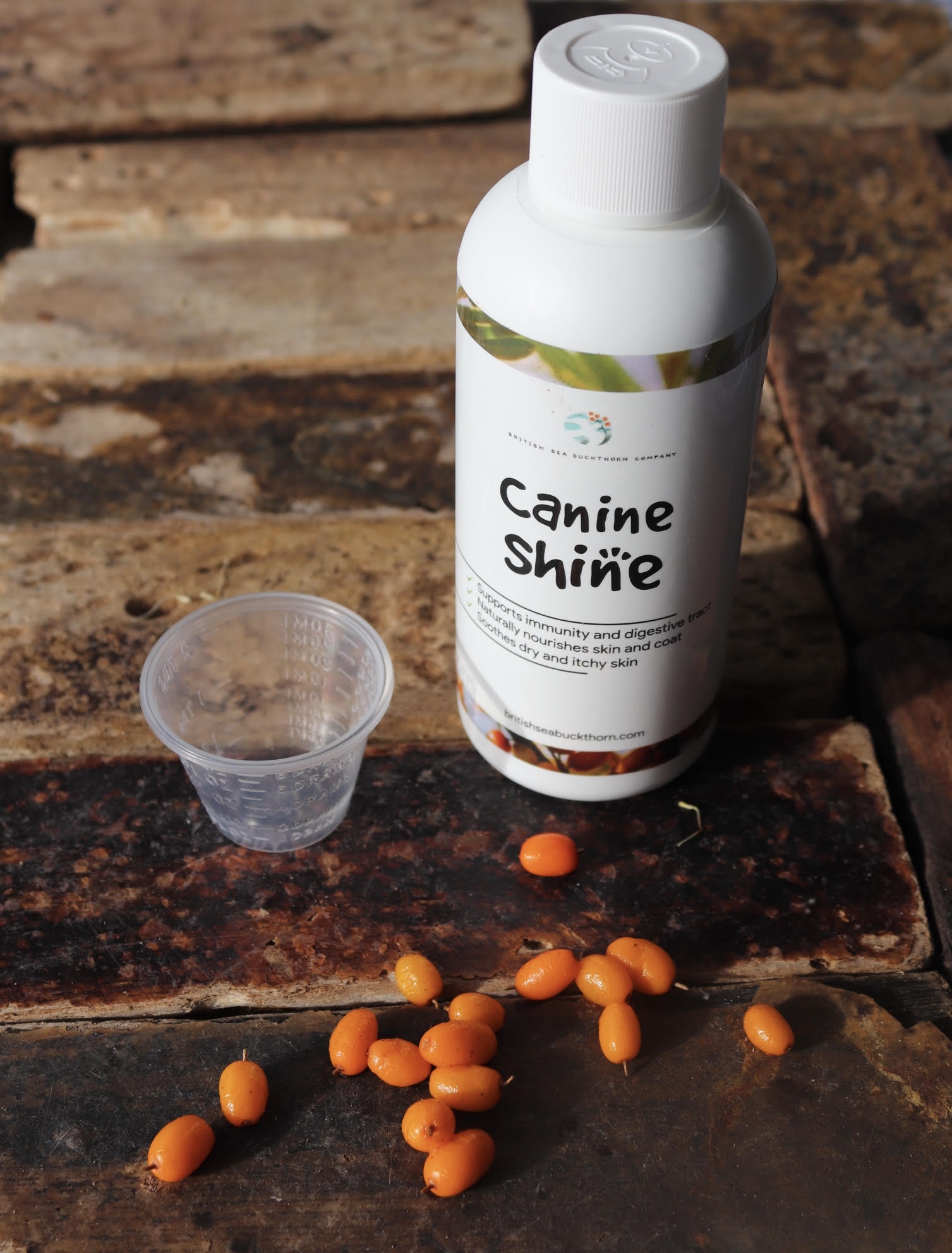 The Ancient Greeks named Seabuckthorn: ‘Hippophae’, which translates as ‘Shiny Horse’. We now know this is because it’s a rich source of many nutrients required in the every-day functioning of healthy skin.
The main oil within skin cells is an Omega 6 called GLA, which boosts blood circulation, hydrates and regulates inflammation within the skin. As well as being a source of this vital oil, Seabuckthorn is rich in Antioxidants and Vitamins A, B and E, all required to keep skin cells healthy, slowing the ‘ageing’ process.
We’re also beginning to understand the crucial role of our gut health in our overall health and wellbeing, thanks to rapidly increasing research. This process is just as vital in animals, with fibre and antioxidant-rich foods nurturing their beneficial gut bacteria. For animals, not all so called ‘prebiotic’ foods are equal – fruit fibre, as well as beet pulp, oats and barley can be especially beneficial to dogs1. Seabuckthorn is a great source of fibre and we’re continuing to explore its influence on gut health.
With feedback from dog owners on Canine Shine, so far being very positive not only for skin condition but general health and wellbeing too, why not treat our most loyal canine companions, & see for yourself, the benefits from nutrient-rich food in its most natural form!
Omega oils are involved in many every-day processes in the body, from transporting vitamins, making hormones and the correct functioning of cells, so they’re of huge importance in our overall health! Seabuckthorn is totally unique in the variety of health-giving Omega oils it contains, not just in its seeds but in the berries too. The seeds are especially rich in Omega 3&6, the two ‘essential fatty acids’ that we are totally dependent on our food for, while the soft parts of the berry are one of very few plants to contain valuable Omega 7. Omega 9 in seabuckthorn, is perhaps better known as Oleic acid, the beneficial fat in olive oil.
The nature of fat in our food depends on the types of fatty acids it contains – saturated and unsaturated. All fats contain both but in general plant oils contain more unsaturated (liquid at room temperature) and fats of animal origin contain more saturated (solid at room temperature). Including more plant oils in our diet is really beneficial for our health (1). Seabuckthorn, as well as being a rich source of Omega oils, also contains plant sterols, natural plant compounds which help to promote good cholesterol levels. It’s also a fabulous source of fat-soluble vitamins A&E. You can read more about all its other beneficial nutrients here but let’s concentrate on those Omegas!
Omega 3 is vital for the structure of our cell membranes which ensure the proper functioning of all our body cells. So, it’s easy to see why a diet rich in Omega 3 gives such wide-ranging health benefits from protecting against heart disease & regulating inflammation to giving our skin a healthy glow! For example, by keeping cell walls flexible, Omega 3 helps to keep blood pressure down (because the cells lining blood vessels stay stretchy) which in turn helps to maintain a healthy heart. The anti-inflammatory function of Omega 3 is especially important in preventing blood clots, (which increase the risk of stroke) but new research is starting to show other benefits such as improved bone density, better outcomes in auto-immune disease like Rheumatoid Arthritis and protection against Dementia in older age. It’s important to mention that there are two types of Omega 3 which are especially important for our vision, brain health and their anti-inflammatory function. These are EPA and DHA and are already present in oily fish. Plant Omega 3 however, needs to be converted by our bodies into these two forms before we can get the same benefits. So, if we’re relying on plants for our Omega 3, we need a lot! (2)
Omega 6 is high in the seeds of seabuckthorn, making up about 40% of the oils there! However, it also accounts for about a third of the oils in the berries too. Omega 6 in our food helps to maintain healthy cholesterol levels by raising ‘good’ HDL cholesterol and lowering ‘bad’ LDL cholesterol. It’s also the most abundant oil in our skin, so as well as promoting a natural glow it can help with acne, atopy and psoriasis. One particular type of Omega 6, GLA (better known perhaps as the beneficial oil in evening primrose oil and borage) is especially high in seabuckthorn and can help to regulate hormonal changes during menopause.
Getting the right balance…
It’s really important to strike the right balance of Omega 6: Omega 3 in our food. Our UK food intake surveys show us that on average most of us manage 6:3 at a ratio of 10:1 but 4:1 is far more beneficial for our health (3). British seabuckthorn contains a balance of 1:1 so provides a very welcome functional food to help us get a good balance.
Omega 7 is rarely found in foods; happily seabuckthorn berries are one of the very few, rich sources. Research has shown Omega 7 to be extremely effective in promoting healthy mucous membranes – the delicate lining of our respiratory and digestive systems. (4) This is one of the reasons why seabuckthorn pulp as a natural food supplement is very popular in preventing stomach ulcers in horses. Having practiced as a Vet before becoming a Nutritionist, I can safely say this is something they’re very prone to especially with the stress of racing. However, it’s the mix of over 190 nutrients in seabuckthorn which is thought to amplify the beneficial effects of these nutrients individually. No wonder then, being packed full of antioxidants like flavanols, Vit C, carotenes (Vit A) and tocopherols (Vit E), that seabuckthorn, having all these nutrients together, can be so beneficial against the long-term effects of stress on digestive health, the cardiovascular system and skin condition. Omega 7 may also be beneficial in Diabetes as it increases our sensitivity to insulin. (4)
Omega 9 is also present in high quantities in olive oil and there are now many links between the olive oil in a Mediterranean-style diet and protection against longer-term heart disease and cancer.
References

Rainfall has become a very unpredictable variable. Last summer our sea buckthorn had to tolerate two months without rain up until the end of September. From then on the rain was incessant creating waterlogged soils until mid-March. I have considered this to be intolerable to sea buckthorn, but we do not seem to have lost any plants as a result.
As we are preparing a field for our new orchard it is being subsoiled to a depth of 1 metre. This cuts a slot forming each row, whilst also shattering the soil at a lower level. As we are told that climate change will give longer periods of drought I want our plants to develop roots that can source deep soil moisture. I believe the subsoil slot provides an easy route through our heavy clay soils, for new roots to grow to a good depth. It may not be conventional wisdom, but our weed control system cuts plant surface roots to encourage deeper rooting.
In 2012 we planted our orchard with varying plant spacing: at 0.8m, 1m, 1.5m and 2m. New plantings in 2015 had spacing of 1.5m, 1.75, 1.85, and 2m. Row widths also are variable across the site – being at 3m, 3.5m, 3.8m and 4m. Having invested in a tractor mounted Ladurna cultivator to control weeds around the plants it has been valuable to be able to see how practical these measurements are when using machinery. The conventional 2m plant spacing and 4m row width provides plenty of machine operation space, but when land is valuable fruit yield can be increased by increasing plant numbers per hectare. Hence our latest new orchard we will be planting with 1.8m plant spacing with 3.8m row widths. This tighter spacing increases plant numbers by 15% per hectare, whilst allowing ease of use of machinery and optimum light for the plants.
Producing fruit is our principle goal, but producing high quality sea buckthorn is our objective. This year I have already started applying foliar feeds. Following trials by Mishulina (1976) there are indications that trace elements of Iodine and boron increase vitamin C levels. Last year’s berry analysis indicated good results with vitamin C in Latvian varieties. This year I will follow the same foliar feed spray cycle but adding two additional sea weed extract applications. This will allow five applications pre harvest. Followed by one seaweed and two foliar feeds in August/September. I have to accept that berry quality is as much a product of variable weather as management intervention, but we will look forward to comparing the 2019 and 2020 berry analysis results as the means of developing consistent berry quality in future crops.

David is a Director of the British Sea Buckthorn Company.
I have often said that the sea buckthorn trial at Devereux farm is a 20 year project. The first ten years saw plants established but also lost to disease. The results are now – after ten years, developing with a cold store with a limited stock of frozen berries from the 2019 harvest. An evolution of progress.
The enthusiasm for sea buckthorn comes as being part of the global community of sea buckthorn growers, researchers, processors and manufacturers. Their collective investment has created expansion in production. Production, as I have found is not easy but the growth of a global sea buckthorn industry has taken 50 years to expand into 40 countries. For all the difficulties of establishing a growing crop – growing a market is an equal challenge, even for a crop based on significant nutritional quality.
Our health is key to being able to enjoy a normal life. Health is not a simple concept. It requires investment. Our personal investment managing our body’s functions has long term implications. Out of sight is often said to be out of mind. Appreciating the ability of our immune system to keep us healthy is easy just to accept. Our digestive system operates unseen, converting food to the vital mix of nutrients our complex body requires to function effectively. But how often do we actually buy food based on respecting the needs of our digestive system – even though it is our own personal system that maintains our own personal health.
There has been a quiet revolution developing in the nutrition world exposing the importance of the gut. There are tens of trillions of bacteria that live in our gut. A multi-functional soup of incredible complexity forming a balanced mechanism that breaks down food into constituent nutrients. This balance of species in this vast population is critical. This is not something of convenience, it is like a Ferrari, fine-tuned for peak performance. Put diesel in your petrol car and you pay for the consequences both by looking foolish and having to repair the damage.
I say all this because I understand the gut microbiome concept but not the detail. The concept is of such importance that it is becoming a subject I need to understand. As I get older I am appreciating the need for good health to allow a quality of life at work and at home.
Within so many issues the word balance is so importance. It is a pet subject of mine but I often reflect back on the Galenic way of life. A set of principles based on times when medicine was rudimentary so personal responsibility to one’s own health was essential. It suggests five principles of the food/drink we consume; the right amount of exercise; working in a positive environment; good sleep and good mental health as forming the basis of preserving our health. There is a sixth principle that requires each being proportionally balanced. A rational approach and one that can work even in the stressful world of 2020.
An interest in food takes you in many directions. Being a farmer in 2020 is concentrating my mind on significant changes coming post-Brexit for our industry. With great change comes the need for ensuring that you fully understand all the implications of change before decisions become irreversible. The current debate around how to feed a growing global population, together with the need to adapt to climate change will require all of us to change – but often evolution is better than revolution. Maintaining a balanced debate, taking all opinions into account and using compromise to bring everyone along a path of change achieves the progress that we really need to solve these issues.
It’s almost a year since I began working with British Seabuckthorn – as a Registered Nutritionist with a particular interest in sustainable foods, healthy for people and planet, this journey is an exciting one… British Seabuckthorn (BSB), responsibly farmed in Essex, contains an abundance of nutrients vital for long-term health and wellbeing. Packed with antioxidants, natural prebiotics, vitamins, minerals, unsaturated oils and many other beneficial phytonutrients, it’s a berry with fabulous potential.
The best food choices not only nurture human health but support the biodiversity of our ecosystems too, from healthy soils to thriving flora and fauna with essential roles to play in maintaining nature as it should be. So, as the British Sea Buckthorn Company nurture these principles in continuing to work hard to develop a crop adapted to our rather unpredictable British climate, here are a few ‘need-to-knows’ about British Sea Buckthorn!
A rich source of antioxidants
Our everyday metabolism uses oxygen. By-products of this process are known as free radicals, which can cause damage to cells in a process known as Oxidative Stress – a key factor in ageing and chronic illness such as heart disease, stroke and cancer. We produce antioxidants all the time in our body cells which, by removing these radicals, keep our cells healthy. Many of the antioxidants we make require Vitamins C and E and British Sea Buckthorn is an excellent source of both. Our recommended daily intake of Vitamin C is 45mg; British Sea Buckthorn often contains more than 400mg/ 100g so it’s a very rich source! (current regulations concerning nutrient claims state a food must contain more than 24mg/ 100g to be ‘high in’ Vitamin C, EU Regulation No 1047/2012) Oxidative stress is higher in Obesity and Type 2 Diabetes so antioxidant need increases here too as it does after endurance or high intensity sport. BSB also contains other, powerful antioxidants including Superoxide Dismutase and Flavanoid polyphenols which have an important role in nurturing our all-important gut bacteria too.
As well as eating a more plant-based diet, we’re encouraged to eat fish at least twice weekly in order to benefit from its Omega 3 unsaturated oils. Many years of firm evidence now show the links between a good intake of Omega 3 and protection against heart disease and stroke in particular due to its anti-inflammatory role. Fish contains particularly beneficial types of Omega 3, DHA and EPA. These aren’t present in plants but a good intake of plant
Omega 3 can be used by the body to make EPA and DHA. Too much Omega 6 in the diet can restrict this process but as sea buckthorn contains far more Omega 3 than Omega 6, it has real potential here too.
FIBRE is a type of carbohydrate that can’t be digested in the small intestine. Instead, it passes to the colon (large intestine) where it’s fermented by billions of gut bacteria to produce many compounds essential for our metabolism. Collectively, the genetic make-up of these bacteria is known as our ‘Microbiome’. With 150x our own genetic makeup, our microbiome is to be nurtured; in fact, our ratio of human cells to bacterial cells is 1:1 so we’re just as much bacteria as we are human! We now know these gut bacteria have key roles in our long-term health, from optimising our immune system to protection against certain types of cancer and weight control. In addition, fibre maintains our ‘digestive health’, helping food to pass more quickly through the gut. In 2016, Public Health England, advised increasing the recommended intake of fibre for children (18g/day) and adults (30g/day), as a result of firm evidence for its health benefits, collected over several years. Sea buckthorn, along with other fruit and veg (diversity is the key to good microbes!) is a great source of fibre and also flavanoid antioxidants mentioned earlier, both of which are an important energy source for our microbiome and our gut health.
With an abundance of nutrients, too many to mention here, I’m excited to be involved with the British Sea Buckthorn story as we work together towards a sustainable food choice with so many potential benefits to our longer-term health.